When I first started selling connecting rods for a living over a decade ago, I used to get calls from people who’d spent hours scrolling through online parts catalogs, only to end up more confused than when they began. One guy last month came in holding a beat-up old connecting rod from a 1998 Ford F-150, asking why every option we listed looked almost the same but cost 3 times more than the cheapest one on Amazon. That moment reminded me: choosing the right connecting rod isn’t just about grabbing the first part that fits your engine block. It’s a balance of what your engine does, the materials it needs, and how much you’re willing to invest in reliability. As someone who’s worked with engine builders, weekend hobbyists, and professional race teams every week, I want to break this down like I do when I sit down with someone at our shop—no jargon, no fluff, just what actually matters. Connecting Rods
First, let’s start with the basics you can’t skip: your engine’s application. A connecting rod for a daily-driven pickup truck that tows a camper every now and then is nothing like the one in a 1,000-horsepower drag racing engine that sees 10-second quarter-mile runs. I’ve seen guys swap a race rod into a daily driver and end up blowing a gasket a month later, just because they thought more strength equals better. That’s backwards. If your engine is mostly for commuting, occasional road trips, and light towing, you don’t need a titanium rod that costs more than your monthly gas bill. You do, however, need to match the rod to the operating RPM. Most stock rods are made from cast iron, and they’re fine for engines that top out around 6,000 RPM. If your engine regularly spins over 6,500 RPM—like a road racer or a build where you’ve added a turbocharger or supercharger—cast iron won’t hold up. It’s brittle, and at high RPM, the repeated flex and stress can cause it to crack.
Next, material is the big one everyone fixates on, but most people don’t stop to ask why they’re picking the material in the first place. There are three main types you’ll see in the market: cast iron, forged steel, and aluminum (for the high-end crowd). Let’s talk through each, from the perspective of what I recommend for different customers. Cast iron rods are the cheapest, and they work for stock or mild build engines. They’re thick and heavy, but for a daily driver that never sees extreme stress, that’s not a problem. The downside? They add unnecessary weight, which hurts RPM and fuel efficiency, and they can’t handle much boost or high RPM. I sold a set of cast iron rods to a guy building a 4-cylinder turbo Honda last year, and he called me two weeks later saying they bent at 7,000 RPM. Turns out he’d upped the boost from 8 PSI to 16, and the cast iron couldn’t take the extra load. Lesson there: know your engine’s limits before you pick a material.
Forged steel is the sweet spot for most people, whether they’re building a mild performance street engine or a weekend racer. Forging means the metal is heated and shaped under pressure, which lines up the grain structure of the steel so it’s way stronger than cast metal. I stock forged steel rods in both 4140 and 4340 steel—those are the two grades every reputable supplier keeps. 4140 is great for mild builds up to around 800 horsepower; it’s affordable, easy to machine, and holds up well to street use. 4340 is for higher stress: if you’re making 800+ horsepower, or running turbo for sustained periods, 4340 is the way to go. It’s a bit more expensive, but the strength is worth it. I’ve seen 4340 rods survive 1,500-horsepower pull after pull in drag racing engines, and they rarely have issues if installed correctly. The only downside to forged steel? It’s heavier than aluminum, which can be a problem for engines that rev really high, because extra rotating weight hurts acceleration. That’s where aluminum comes in.
Aluminum rods are for race engines only, period. They’re 30-40% lighter than steel, which lets engines rev faster, a huge benefit for road racing or drag racing where every tenth of a second counts. But they’re not as strong as steel, and they wear faster under heavy, repeated load. I don’t recommend aluminum for street engines—stop-and-go traffic, potholes, and the occasional over rev will wear down aluminum rods much quicker than steel. A friend who builds NASCAR engines swears by aluminum for short, high-RPM runs, but he’ll swap to steel for any race that has a longer duration or more stress. If you’re not turning laps at a track every weekend, aluminum is overkill.
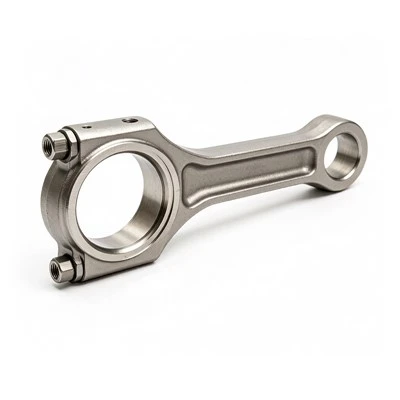
Once you’ve nailed down material and application, the next thing to check is rod length and big/small end dimensions. This is where a lot of people go wrong: they measure the old rod wrong, or they pick a length that changes the engine’s compression ratio or timing. Rod length is the distance between the center of the small end (where the piston pin goes) and the center of the big end (where the crankshaft journal sits). Changing even a quarter of an inch can alter your engine’s stroke and compression. For example, if you’re building a 350 Chevy, the stock rod length is 5.7 inches. If you go to a 6.0 inch rod, that changes the rod-to-stroke ratio, which affects how the piston moves in the cylinder, and can raise compression by a few points. That’s not necessarily bad, but you need to plan for that when you’re picking a piston. If you’re mixing aftermarket parts, make sure your rod length matches the piston’s compression height—another thing I help people with all the time, because getting that wrong means the piston will be too far up or too far down in the cylinder, leading to engine damage.
The big end and small end dimensions matter too. The small end has to fit your piston pin—if the hole is too big, the pin will wobble, and if it’s too small, you’ll spend hours machining it, which adds cost. The big end has to fit your crankshaft’s rod journal. For most aftermarket rods, they come with a machined big end that you can hone to fit your specific journal, but some are already sized for certain cranks. Double-check that before you order: I once had a customer order a set of rods for a Ford 302, only to find out the big end was sized for a 351W crank, not the 302 he had. He had to send them back, and he lost a week of build time. That’s the kind of mistake I try to prevent by walking through each dimension with someone when they call.
Then there’s the issue of manufacturing quality, and this is where a lot of the cheap options fall apart. I’ve had customers bring me rods they bought online for $50 a piece, asking why they bent after a few hundred miles. More often than not, those are made from low-quality steel, or they’re not properly heat-treated. Forging isn’t just shaping metal—it’s heating it to a specific temperature and cooling it slowly to make it strong. Cheap rods skip that step, or use recycled metal with inconsistent grain structure. I only stock rods from manufacturers that do the forging in-house, and that have third-party testing to verify strength. I even test a random sample from every batch we get, just to make sure there’s no defect. Last year, a new supplier sent me a batch of rods, and one of them cracked during our pressure test before it even went to a customer. That’s why quality matters more than price, even when you’re on a budget.
Another thing people forget: the rod’s bearing compatibility. The big end of the rod sits between two bearings that ride on the crankshaft. If you pick a rod, you need to make sure it works with standard or oversized bearings, depending on your crank. Most aftermarket rods are made for standard size bearings, but some are designed for race bearings that are thicker. I always ask customers to bring their old bearings when they come in, so I can match the rod to the right bearings, because putting the wrong bearings in can cause metal-on-metal contact, which wears down the crank and the rod. I had a customer a few months ago who didn’t check that, and he had to replace his entire crankshaft because the bearings were too thin, and they wore through after 1,000 miles. That’s a costly mistake that’s easy to avoid.
Let’s wrap this up with a real example, to make it concrete. Say you’re building a 1980 Chevy C10 with a 350 small block, you’re putting on a single turbo, and you want to tow your boat on weekends, but you also want to run it up to 6,500 RPM on back roads. What do you pick? First, application: mild performance, street use, occasional towing. Material: forged steel, since 6,500 RPM is too high for cast iron, and aluminum is overkill. Grade: 4140 is enough here, since you’re not making more than 800 horsepower. Rod length: stick with 5.7 inches, matching the stock rod, unless you’re changing pistons specifically to adjust compression. Dimensions: confirm the big end fits a standard 2.100 inch journal, and the small end fits your piston pin size. Quality: go with a reputable forged rod, not the $50 Amazon specials, because you don’t want to risk it on a build that’s going to see regular use. That’s exactly the kind of build I help people plan every week, and it turns out reliable, not just powerful.
If you’re still not sure, here’s my advice: don’t guess. I’ve talked to so many people who think they can figure it out on their own, only to end up with parts that don’t fit, or parts that fail. You don’t have to be an engine expert to pick the right connecting rod. All you need is to bring your engine’s specs—what make and model it is, what build you’re doing, what horsepower you’re targeting—and talk to someone who knows the business. We’ve been selling connecting rods for over a decade, and we work with every kind of engine build, from stock street cars to pro race teams. We don’t push the most expensive part; we push the part that fits your needs and your budget. Whether you’re ordering online or stopping by our shop to look at the parts in person, just reach out and we’ll walk through every step with you, no pressure. We’ll go over material, dimensions, quality, and make sure you leave with a rod that will hold up for years, not just a few months.
Choosing the right connecting rod is one of the most important decisions you’ll make when building or rebuilding an engine. It’s a part that takes every force your engine produces, and if it’s wrong, it can destroy your entire engine in a matter of seconds. Don’t cut corners here. Do your research, pay attention to material and dimensions, and don’t be afraid to ask for help. We’re here to make that process easy, so you can get back to driving or racing your engine, not fixing it.
Connecting Rods References
- "Connecting Rod Design and Application," SAE International, 2021
- "Materials for Engine Components," Society of Automotive Engineers, 2019
- Performance Automotive Engine Building Handbook, CarTech Books, 2020
- "Forging Processes for Automotive Parts," Forging Industry Association, 2018
- Aluminum vs. Steel Connecting Rods: Performance and Durability Comparisons, Hot Rod Magazine, 2022
Zhejiang Jintai Copper Industry Co., Ltd.
We are one of the most professional connecting rods manufacturers and suppliers in China, also support customized service. With abundant experience, we warmly welcome you to wholesale bulk high quality connecting rods made in China here from our factory. For quotation, contact us now.
Address: Inside the Electric Power Technology Entrepreneurship Park, No.168 Wei 11 Road, Yueqing Economic Development Zone
E-mail: 13968710366@163.com
WebSite: https://www.jintaicopper.com/
