If you’ve ever walked through a manufacturing facility producing air cushions, medical blister packs, or PVC signage, you’ve probably felt the distinct hum of a high-frequency (HF) welding machine—one that’s become a workhorse for soft, thermoplastic materials. As a Shuttle Table HF Welding Machine supplier, I’m often asked by production managers, design engineers, and small business owners to break down how these machines stack up against another common welding technology: laser welding. The question isn’t just which is “better”—it’s which fits a specific project’s needs, budget, and material type. Let’s cut through the technical jargon and compare these two technologies side by side, grounded in real-world use cases from the hundreds of operations I’ve partnered with over the years. Shuttle Table HF Welding Machine
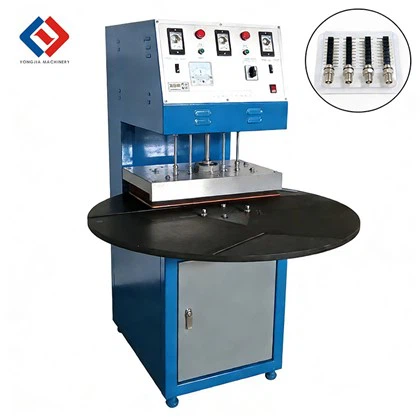
First, let’s start with the basics so we’re all on the same page. Shuttle Table HF Welding works by using high-frequency electrical energy (usually 27.12 MHz, an ISM band reserved for industrial use) to excite the dipolar molecules in thermoplastic materials like PVC, polyurethane, or TPU. As these molecules vibrate, they generate heat that melts the material’s surface, and simultaneous pressure from the machine’s tooling fuses the layers together. The “shuttle table” design refers to a moving work surface that slides a finished part out while a new one is positioned under the welding head, cutting down on downtime between cycles.
Laser welding, by contrast, uses a focused beam of coherent light (most often infrared for thermoplastics) to deliver targeted energy to the weld zone. The beam can be directed with mirrors or fiber optics, making it ideal for precise, intricate patterns or non-contact work. But that’s where the similarities end—and where the trade-offs become clear, depending on what you’re manufacturing.
Let’s dive into material compatibility, because this is the first pain point I hear from customers. For Shuttle Table HF Welding, it’s best suited for polar thermoplastics—materials with molecules that have a slight electrical charge, so they react to the HF field. That includes most common flexible thermoplastics: PVC, which is ubiquitous in inflatable products, medical bag liners, and signage; TPU, used for durable gear and footwear components; and polyester blends that include a polar base resin. What it can’t handle well are non-polar thermoplastics like polypropylene (PP) or polyethylene (PE), because their molecules don’t respond to the HF energy. If your project uses non-polar materials, HF welding won’t work for you—and laser welding will be a solid option, since lasers can be calibrated to bond even non-polar thermoplastics (or use an absorptive dye to help the light stick).
The catch, though, is material thickness and flexibility. Shuttle Table HF Welding excels with thin, flexible materials—usually from 0.1 mm to 5 mm, depending on the machine’s power output. My customers regularly weld 0.2 mm PVC for medical surgical drapes and 3 mm TPU for inflatable kayaks without any warping or weak spots. Laser welding, on the other hand, works better for rigid or semi-rigid parts, and thin flexible materials can be tricky: the focused light can overheat small areas, leading to burning or stretching, especially if the material shifts during the weld. For the inflatable boat I mentioned, a laser would likely struggle to create a uniform, airtight weld along a 10-foot seam, while a Shuttle Table HF machine can process that seam in minutes, no special alignment tweaks needed.
Next up, production speed and efficiency—two metrics that keep factory floors running on schedule. This is where Shuttle Table HF Welding has a distinct edge for high-volume, repetitive work. The shuttle table design lets operators load a new part while the previous one is being welded, so cycle times are often 10 to 30 seconds per part, depending on size. For example, a customer of mine making 10,000 PVC water bags a month uses a 5-station Shuttle Table HF machine to produce each bag in 15 seconds, with zero downtime between cycles. They recently tried switching to laser welding and found it took twice as long per part, plus the laser required constant calibration to maintain weld quality, cutting their overall output by 40%.
Laser welding’s speed advantage comes with fine, delicate work—think tiny electronic components, medical devices with micro-welds, or intricate patterns for custom signage. For a 1 mm weld on a pacemaker component, a laser can precisely target a 0.5 mm spot without touching surrounding material, something a standard Shuttle Table HF machine can’t do (the HF field has a small “dead zone” at the edges of the tooling, so micro-welds would need a specialized small-head HF machine that’s slower and more expensive). But for most high-volume flexible thermoplastic applications, HF outpaces laser by a wide margin.
Cost is another huge factor, and here the line blurs a bit depending on your operation. The upfront cost: A basic Shuttle Table HF Welding Machine for small to medium production runs costs between $8,000 and $25,000, depending on power output and shuttle size. Industrial-grade models for large-scale manufacturing go up to $60,000, but even that’s often less than a comparable laser welding system for flexible materials, which can start at $15,000 for entry-level models and jump to $100,000+ for high-precision, high-power units. The ongoing operational costs also favor HF: HF machines use standard electrical power, and their tooling (the molds that shape the weld) is made of aluminum or steel, which is low-cost to produce and replace. Laser machines, by contrast, require expensive laser diodes that need replacement every 10,000 to 50,000 hours of use, plus specialized lenses and calibration tools that add to long-term costs.
But there’s a caveat for small-batch, custom work: If you only need to produce 50 to 100 custom parts a month, a Shuttle Table HF machine’s tooling costs might add up if you’re changing molds frequently. A custom HF tool for a unique design can run $500 to $2,000, while a laser can be programmed to weld different patterns without retooling, making it cheaper for small runs. For high-volume, standard parts, however, the mold cost is amortized over thousands of units, and HF remains far more cost-effective.
Quality and consistency are make-or-break for manufacturing, so let’s talk about what each technology delivers. Shuttle Table HF Welding produces welds that are as strong as the base material—often stronger, actually, because the heat and pressure melt the material’s entire surface layer, rather than just fusing a small top layer like adhesive or some laser welds. For products that need to hold pressure, like air mattresses or IV bags, this is critical: a weak weld will leak, and HF welds rarely fail under standard use. The shuttle table design also adds consistency: as long as the tooling is aligned properly, every weld is identical, no matter how many parts you produce.
Laser welding can also produce strong welds, but the quality depends heavily on setup. If the beam is misaligned, or the material absorbs too much (or too little) light, the weld can be brittle or have gaps. For example, a customer in the packaging industry tried laser welding blister packs and found that 1 in 200 packs had a weak seal because the plastic’s pigment blocked the laser beam. Switching to a Shuttle Table HF machine eliminated that issue entirely, as HF welding doesn’t rely on light absorption—only the material’s dipolar properties. On the flip side, laser welding is non-contact, which means no tooling wear and no risk of marking delicate parts—something HF can do if the tooling is too tight. For sensitive products like food packaging, where a scratch on the surface is unacceptable, laser is often preferred.
Safety is a final point I bring up with every customer, because workplace safety is non-negotiable. Shuttle Table HF Welding machines produce high-frequency electromagnetic radiation, which is contained by grounded metal enclosures, so as long as the machine is maintained and not tampered with, there’s no risk to operators. They also use low-voltage internal components, and most models have safety sensors that stop the cycle if an operator’s hand is near the tooling. Laser welding, by contrast, produces high-intensity light that can damage eyesight if proper eye protection isn’t worn, and the fumes from welding plastic (especially PVC) can be more concentrated with laser, as the focused heat burns the material rather than melting it cleanly. That means laser welding facilities often need specialized ventilation, while most Shuttle Table HF setups only require basic exhaust for minor fumes.
So where does this leave you? If you’re manufacturing products like inflatables, medical pouches, flexible signage, or footwear components—products that use polar thermoplastics and need high-volume, airtight, strong welds—Shuttle Table HF Welding is almost always the better choice. It’s faster, cheaper, more consistent, and works with the materials those industries rely on. If you’re working with non-polar thermoplastics, tiny micro-components, or need non-contact welding for delicate parts, laser is the way to go.

At the end of the day, the best technology depends on your specific needs—not what’s the newest or most expensive. As a Shuttle Table HF Welding Machine supplier, I’ve helped operations of all sizes choose the right equipment for their projects, and I’m here to walk you through your options, answer questions about material compatibility, and find the machine that fits your production goals. If you’re ready to discuss your welding needs, reach out to arrange a consultation to review your specific requirements.
Fully Automatic Hot Press Welding Machine References
- Manufacturing Engineering Society International Conference, “High-Frequency Welding of Thermoplastics: Process Parameters and Material Compatibility,” 2021.
- Laser Institute of America, “Comparative Analysis of Laser Welding and High-Frequency Welding for Thermoplastic Materials,” 2019.
- Journal of Industrial Manufacturing, “Shuttle Table Automation: Efficiency Gains in High-Voltage Welding Operations,” 2022.
- Medical Device Manufacturing Association, “Welding Technologies for Flexible Medical Components: Strength and Safety Standards,” 2020.
Dongguan Yongjia Machinery Equipment Co., Ltd.
We are one of the most reliable shuttle table hf welding machine manufacturers and suppliers in China, specialized in providing high quality customized service. Please feel free to wholesale advanced shuttle table hf welding machine at low price from our factory. For quotation, contact us now.
Address: No. 240, Chashan South Road, Chashan Town, Dongguan City, Guangdong Province, China
E-mail: info@yjwelding.com
WebSite: https://www.yjhighfrequencymachine.com/
