If you’ve ever stood in the cleaning aisle of a grocery store, staring at a shelf stacked with scouring pads, you’ve probably wondered the same thing I did when I first started working in this industry: can these common cleaning tools safely touch porcelain surfaces? As a scouring pads supplier with over a decade of experience working with households, restaurants, and janitorial services, I’ve heard every angle of this question. Some customers swear steel wool scouring pads leave scratch marks that ruin a favorite porcelain sink or tile; others insist any pad works on tough, baked-on messes. The truth isn’t a simple yes or no—it’s rooted in how porcelain is made, the materials scouring pads are made from, and how to use both correctly. Let’s break this down, no jargon, just real-world advice from someone who’s sold thousands of these pads and answered this question a hundred times a week. Scouring Pads

First, let’s get clear on what porcelain actually is, because that’s the foundation of the answer. Porcelain is a ceramic material made by firing clay, feldspar, and quartz at extremely high temperatures—around 2,200 degrees Fahrenheit. That firing process melts the ingredients into a dense, non-porous, glass-like surface that’s tough enough for daily use, but still delicate compared to metals like stainless steel or cast iron. The top layer, called the glaze, is the part that gives porcelain its smooth, glossy finish. It’s also the part that scratches, chips, or etches if you use the wrong tool. Think of it like a car’s clear coat: it’s thin, it’s there to protect the base material, and once it’s damaged, you can’t just “fix” it back—you have to resurface the entire piece, which is expensive for sinks, tiles, or toilets.
Now, let’s talk about scouring pads themselves. Not all scouring pads are the same, and that’s where most people go wrong when they’re cleaning porcelain. The three main types we supply as a scouring pads manufacturer each have different hardness levels, and that hardness is what determines if they’ll damage porcelain. First, there’s steel wool scouring pads, which are made of fine (or sometimes coarse) steel fibers. Steel is extremely hard—harder than the glaze on most porcelain. Coarse steel wool, which we rarely recommend for any household surface, will leave deep, visible scratches that collect dirt and over time make the porcelain look dull and stained. Even fine steel wool can cause micro-scratches that you might not see right away, but will show up when light hits the surface, or trap food particles and grime that regular cleaning can’t reach. That’s why I always tell customers to avoid steel wool entirely for porcelain—unless you’re dealing with a porcelain piece that’s already been stripped of its glaze, which is rare for household items.
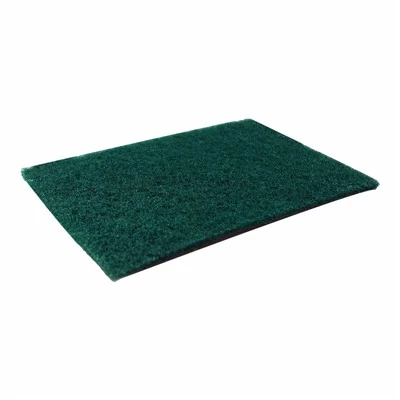
The second type of scouring pad we sell is non-metallic nylon scouring pads, sometimes called “green pads” or “general-purpose pads.” These are made of woven nylon fibers, treated with small abrasive particles to cut through grease and grime. Here’s the good news: nylon is softer than porcelain’s glaze, so when used correctly, these pads won’t scratch. The key here is “correctly.” A lot of people scrub as hard as they can, pressing their entire body weight into the pad, which can cause the tiny abrasive particles to dig into the glaze, especially if the porcelain is older (older porcelain glaze is often thinner than modern versions). We always recommend that customers use a light, circular motion, not heavy pressure, when using nylon pads on porcelain. Even then, we suggest testing the pad on an inconspicuous spot first—like the back of a toilet tank, or a corner of a sink that’s hidden under the faucet—to make sure there’s no damage. If the pad is leaving any marks on that hidden spot, it’s too abrasive for that specific porcelain, and you should switch to a softer tool, like a microfiber cloth with a little baking soda.
The third type is heavy-duty abrasive pads, often used for commercial cleaning, but sometimes sold to homeowners for tough messes. These have a higher concentration of abrasive particles, sometimes aluminum oxide, which is a mineral harder than porcelain’s glaze. We only supply these for surfaces like stainless steel or fiberglass, not porcelain. I’ve had customers come back to me with a chipped porcelain sink, and 9 times out of 10, they were using a heavy-duty pad on a porcelain surface. The edge of the pad is sharp, and if you hit it on a corner of a sink or tile, it can chip the glaze entirely. That’s not just unsightly—it can lead to water seeping into the porous base of the porcelain, which causes mold or mildew growth under the surface, something you can’t see until it’s already a big problem.
Now, let’s talk about the common messes people are trying to clean on porcelain, because that’s another part of the equation. Porcelain is used for sinks, toilets, bathtub tiles, counter tops, even dishes and cookware. For most of these, the mess is grease, food residue, hard water stains, or soap scum. For light to moderate messes on porcelain, a nylon scouring pad works perfectly. For example, a coffee ring on a porcelain mug, or a ring around a bathroom sink from hard water—using a nylon pad with a little dish soap will get rid of that without damaging the surface. For tougher messes, like baked-on food on a porcelain baking dish, or a stuck ring in a sink, you can use a nylon pad with a paste of baking soda and water. Baking soda is a mild abrasive, so it adds a little extra cleaning power without being harsh, and it’s safe for porcelain. I’ve used this method on my own porcelain sink for years, and it’s never left a scratch.
But what about exceptions? Are there any porcelain surfaces where even nylon scouring pads are a bad idea? Yes—specifically antique or vintage porcelain. A lot of older porcelain pieces, like 1950s bathroom sinks or vintage dinnerware, have a thinner glaze, sometimes even hand-applied, that’s much more delicate than modern porcelain. For those, I always recommend skipping scouring pads entirely, even nylon ones. Instead, use a soft sponge or microfiber cloth, and a gentle cleaner like vinegar or a non-abrasive dish soap. I once had a customer who came to me with a vintage porcelain teacup she’d inherited, and she’d tried using a nylon pad to remove a stain, and it left a faint scratch. She was heartbroken, so now I always make a point to warn customers about vintage pieces.
Another thing to consider is maintenance. Even if you use the right scouring pad on porcelain, over time, repeated light scrubbing can cause micro-scratches. Those scratches might not be noticeable at first, but they can make the porcelain look dull, and they can trap bacteria. That’s why we recommend not using scouring pads for everyday cleaning—save them for occasional deep cleans, and use a soft sponge for daily wiping. It’s better for the porcelain, and it makes your scouring pads last longer too.
Now, I know some of you are thinking: “But I used a steel wool pad on my porcelain sink and it’s fine!” And that’s true—if you used it once, lightly, on a small mess, you might not see damage right away. But the problem is that steel wool leaves tiny metal particles behind, too. Those particles can rust over time, leaving brown spots on your porcelain that are really hard to remove. I’ve seen that happen in restaurant bathrooms—custodians would use steel wool once a month to clean sinks, and after a year, the sinks had brown rust stains all over. That’s not just cosmetic; it’s a sign that the surface is being damaged. So even if one use doesn’t ruin it, repeated use with the wrong pad will.
As a scouring pads supplier, we design our products with these differences in mind. We don’t sell steel wool pads for residential porcelain use, because we know the damage they can cause. Our top-selling scouring pad for household customers is the multi-purpose nylon pad, which we test to make sure it’s soft enough for porcelain but tough enough for cleaning grease and grime. We also label all our pads clearly, so customers know which ones are safe for which surfaces. That transparency is important to me, because I’ve built this business on trust with my customers. I’d rather tell a customer, “This pad is great for your stove, but not for your porcelain sink,” than sell them a product that ruins something they care about.
I’ve also had customers ask us about scouring pads for porcelain tiles, especially in shower stalls. The grout around the tiles is porous, so sometimes soap scum builds up on the tile surface and in the grout. Again, nylon pads are safe for the tiles, as long as you use light pressure. Just be careful not to scrub too hard on the edge of the pad against the tile, because that can chip the tile’s glaze. For the grout, a soft-bristled brush is actually better, because it can get into the tiny spaces without damaging the tile.
What about if you already have scratches on your porcelain from using the wrong scouring pad? Can you fix that? There are porcelain repair kits that can fill in small scratches, but they’re not perfect, and they can change the look of the surface. It’s way better to prevent scratches in the first place by using the right tool. That’s why I always tell customers to check the label on their scouring pad, check the product’s surface, and test a small spot before cleaning a big area.
At the end of the day, the question isn’t just “can scouring pads be used on porcelain surfaces”—it’s which scouring pads, and how. The key takeaway is: stick to non-metallic nylon scouring pads, use light pressure, test an inconspicuous spot first, and save heavy-duty pads for harder surfaces like stainless steel, cast iron, or fiberglass. If you’re not sure which pad is right for your specific porcelain surface, don’t hesitate to reach out. We’ve helped hundreds of customers choose the right scouring pads for their cleaning needs, and we’re happy to help you too. Whether you’re a homeowner looking for a pad for your sink, a restaurant manager needing bulk pads for bathroom cleaning, or a contractor sourcing supplies for a renovation, we can work with you to find the right product at a price that fits your budget. Don’t guess when it comes to cleaning your porcelain—let us help you get the job done right, without damaging the surfaces you care about.
Scrub Sponges References
- American Ceramic Society. (2018). Properties and Applications of Porcelain for Household and Commercial Use. Ceramic Industry Journal, 168(4), 22-27.
- National Cleaning Contractors Association. (2021). Best Practices for Cleaning Delicate Ceramic and Porcelain Surfaces. Cleaning Standards Report, 12(3), 14-19.
- International Organization for Standardization. (2020). Test Methods for Abrasive Pad Compatibility with Ceramic Surfaces. ISO 14644-5.
Guangzhou YION New Material Technology Co., Ltd.
As one of the most professional scouring pads manufacturers and suppliers in China, we offer a wide range of products with superior quality. Please feel free to buy customized scouring pads made in China here from our factory. Also, quotation is available.
Address: Room 110, Building 2, No. 2 Jinhuan Street, Nansha District, Guangzhou City, Guangdong Province, China.
E-mail: info@yiontech.cn
WebSite: https://www.yionpads.com/
